Articles with tag community

Hello testers, Kiwi TCMS has taken on a brave new mission! We would like to transform the testing process by making it more organized, transparent & accountable for everyone on your team. Our goal is to improve engineering productivity and participation in testing. The following blog post outlines how we would like to achieve this and what goals we put before ourselves for this year.

Complete the internal refactoring

Last year we took on the challenge to bring a legacy code base up to modern coding standard. We did not complete that effort but made very good progress along the way. This is not a small task and that's why our team will continue with it this year.
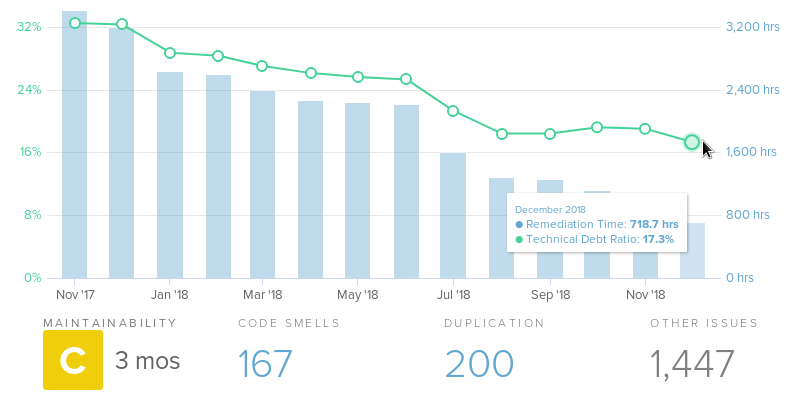
CodeClimate report

  • CodeClimate: 0 issues, 0% technical debt, health score A
  • Scrutinizer: only A and B type issues
  • Pylint: 0 issues
  • Remove vendored-in Handlebars, jQuery, jQuery-UI and TableDnD JavaScript libraries in favor of existing npm dependencies
  • Front-end uses the existing JSON-RPC instead of backend views that are only used for AJAX requests. Tip: these are usually accessed via postToURL() and jQ.ajax() on the front-end
  • Inspect and classify all 3rd party issues reported from Coverity and Bandit. Report and fix what we can, ignore the rest that do not affect Kiwi TCMS.

Redesign the UI templates with the help of Patternfly

There are 59 templates remaining to be converted to a modern look and feel. Along with them comes more refactoring and even redesign of the existing pages and the workflow around them. Together with refactoring this will make Kiwi TCMS easier to use and also to maintain.

Modernize reporting

We are planning to remove the existing reports feature because they are not well designed. We will re-implement existing functionality that our community finds useful, add new types of reports (incl. nicer graphics and UI) and make it possible for the reporting sub-system to be more easily extendable.

Phase out is planned to begin after 1st March 2019! Until then we are looking for your feedback. Please comment in Issue #657!

Plugins for 3rd party test automation frameworks

These will make it easier to collect results from automated test suites into Kiwi TCMS for later analysis. Instead of creating scripts that parse the results and talk to our API you will only have to install an additional package in your test environment and configure the test runner to use it! Automation test results will then appear inside Kiwi TCMS.

If you would like to use such functionality leave your vote inside GitHub issues! In case you would like to write a test-runner plugin you can find the specification here.

Redefine bug-tracker integration

Question: Does Kiwi TCMS integrate with JIRA?

Answer: Well, it does. How exactly do you want to integrate?

... silence ...

The following dialog happens every time someone asks me about bug-tracker integration, especially with JIRA. The thing is integration is a specified set of behavior which may or may not be desired in a particular team. As of now Kiwi TCMS is able to open a URL to your bug-tracker with predefined field values, add comments to bug reports and report a simple summary of bugs inside a TestRun.

We recognize this may not be enough and together with the community we really need to define what bug tracker integration means! The broader domain of application lifecycle management tools (of which TCMS is a sub-set) have an integrated bug tracking system. We can add something like this and save you the trouble of using JIRA, however many teams have already invested in integrating their infrastructure or just like other tools. For example we love GitHub issues and our team regularly makes public reports about issues that we find internally!

GitHub flow integration

Developers have their GitHub PR flow and if they have done the job of having unit tests then they will merge only when things are green! This leaves additional testing efforts kind of to the side and doesn't really help with transparency and visibility. I'm not going to mention having an automatically deployed staging environment for every change because very few teams actually have managed to do this effectively.
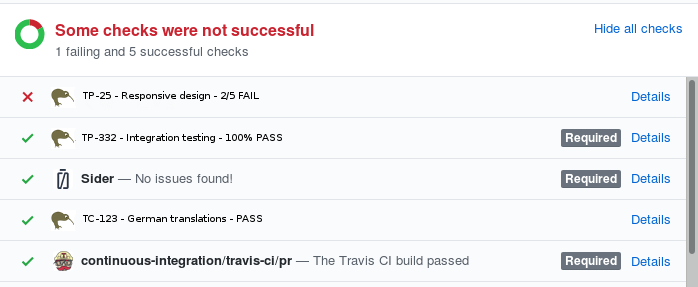
Kiwi TCMS statuses on GitHub PR

  • Goal: Figure out how Kiwi TCMS can integrate with GitHub flow and bridge the gap. Please share and +1 your wildest ideas in Issue #700.
  • Follow up: depending on the results in #700 we will follow with other goals and sub-tasks

Agile integration with Trello

Speaking of modern engineering flow is your team truly agile? When and how do you plan your testing activities ? Before the devel sprint or afterwards? How many testers take part in refining product backlog and working on user stories?

Similar to GitHub flow lots of teams and open source projects are using Trello to effectively organize their development process. Testing should not be left behind and Kiwi TCMS may be able to help.

  • Goal: Figure out how Kiwi TCMS fits into the overall devel-test-planning process for agile teams and what we can do to make this easier for testers. Please share and +1 your wildest ideas in Issue #701
  • Follow up: depending on the results in #701 we will follow with other goals and sub-tasks

Improve engineering productivity

What makes a test engineer productive when they need to assess product risk and new features, when mapping product requirements documents (PRD) to test plans and test cases, when collaborating on user stories and behavior specification ? What makes developers, product owners, designers and other professionals productive when it comes to dealing with testing ?

For example consider the following workflow:

  • Company has idea for a new product
  • In case this is a big product it may have its own mission, i.e. what kind of problem is it trying to solve and for which group of customers
  • Product backlog is then created which outlines features that map to the product mission
  • Then the team, together with test engineers perform example mapping and discuss and refine the initial feature requirements. User stories are created
  • Behavior specification may also be created
  • Test plans and test cases are the immediate product of BDD specs and desired user stories

Later we iterate through the sprints and for each sprint something like this happens:

  • Desired product features are planned for development. They must be complete at least in terms of requirements, specs and tests
  • Devel writes code, maybe some unit tests, testers can also write automated tests and/or manually verify the current state of the feature being developed
  • Testing, including exploratory is performed before feature is merged
  • Rinse and repeat

Devel is also part of testing, right? Product owners, UX and interaction designers as well. Producing quality software product is a team effort!

In every step of the way Kiwi TCMS can provide notification wizards, guidelines and/or documentation for best practices, facilitate tooling, e.g. to write user stories and assess them or map out an exploratory testing session, etc. The list of ideas is virtually endless. We can even go into deep learning, AI and blockchain but honestly who knows how to use them in testing ?

Our team is not quite sure how this goal will look like 3 months from now but we are certain that testing needs to happen first, last and all the time during the entire software development lifecycle. By providing the necessary functionality and tools in Kiwi TCMS we can boost engineering productivity and steer the testing process in your organization into a better, more productive direction which welcomes participation from all engineering groups.

Let's consider another point of view: testing is a creative activity which is benefited by putting your brain into a specific state of mind! For example Gherkin (the Given-When-Then language) has the benefit of forcing you to think about behavior and while doing so you are vocalizing the various roles in the system, what kind of actions are accepted and what sort of result is expected! Many times this will help you remember or discover missing scenarios, edge cases and raise even more questions!

Crazy ideas, brain dumps and +1 as always are welcome in Issue #703.

Community

Coding alone is not fun! Here's what you can do to help us:

We are also looking to expand our core team and the list of occasional contributors. The following are mostly organizational goals:

  • Goal: participate in 5 conferences with a project stand
  • Goal: define how we find, recruit and onboard new team members. The foundation is already set in TP-3
  • Goal: clearly mark GitHub issues which are suitable for external contributors which don’t want to spend lots of time learning how Kiwi TCMS works under the hood. We're going to tag all such issues with the GitHub help wanted label

Development policy

Our team will be working on areas related to the goals above. A +1 reaction on GitHub issues will help us prioritize what we work on!
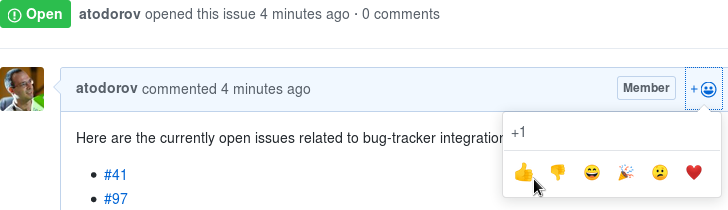
GitHub +1

Bug fixes and other issues will be occasionally slipped into the stream and pull requests from non-team contributors will be reviewed and merged in a timely fashion.

There is at least 1 full day of work that goes behind the scenes when a new version is officially released: compile changelog, build images and upload them, create blog post and newsletter announcement, share on social media, etc. We also deploy on our own Kiwi TCMS instance as a stop-gap measure before making everything public!

New PyPI tarballs and Docker images will be released every few weeks as we see fit, this has been our standard process. We try to align releases with Django's release schedule and try to cut a new version when there are known security vulnerabilities fixed. However we can't guarantee this will always be the case!

If you are in a hurry and need something quickly the best option is to send a pull request, build your own Docker image from source and maybe consider sponsoring us via Open Collective!

Happy testing!

Roadmap status report for 2018

Hello everyone, in this article I will outline the progress that the Kiwi TCMS team has made towards achieving the goals in our 2018 roadmap (mid-year update here). TLDR; goals are completed at 62%. Refactoring legacy code is showing good results, less so on the front-end side and there are items still in progress!

Make code easier to maintain

Status: good progress

Initially CodeClimate reported a "D" rating with 600+ code smells and 600+ duplications and a 1 year estimation to resolve these. We're now down to "C" rating with 171 smells and 203 duplications.

The level of technical debt has dropped from 32.5% down to 17.7% and we have removed around 14000 lines of Python code and 8000 lines of JavaScript code without losing significant functionality.

Checkout the stats for more info!

Use pylint and pylint-django

Status: almost finished

Both pylint and pylint-django have been integrated into our CI workflow. There are even some custom built plugins that we use. The number of issues reported is down to 100 from 4000+ initially. These are predominantly fixme comments which are also in parts of the code that are scheduled for removal and refactoring.

Render HTML, return JSON

Status: moderate progress

Several views were modified to return pure JSON but we've not done any targeted work to resolve this issue. A number of other views have been removed in favor of using the existing JSON-RPC layer.

This is an internal refactoring effort which isn't very visible from the outside. This is also one of the factors contributing to the high number of removed source code.

Submit forms, post JSON, GET clean URLs

Status: no progress

Not much has been done in this area except the occasional refactoring to JSON-RPC.

API layer

Status: complete

Documentation

Status: moderate progress, dropped

All RPC methods have been documented! The rest of the internals will be documented as we go along.

No vendored JavaScript libraries

Status: good progress

We still carry around jQuery, jQuery-UI and Handlebars.js. They will be removed once the pages using them are converted to use the Patternfly widgets library.

Less HTML templates with better organization

Status: moderate progress

There are still over 50 HTML templates in tcms/templates/ that need to be refactored into Patternfly. We've been working on them one at a time and will focus more on this effort in the next couple of months.

Modern interface with Patternfly

Status: moderate progress

Some of the pages have been converted to use Patternfly. The most important pages that still have a different look and feel are TestPlan view, TestCase view and TestRun view. These are also the hardest to convert because they have lots of tabs/components which pull information from various places. Our goal is to create reusable widgets for the various components (e.g. a list of TestCases) and then include these components into several different templates to minimize code duplication.

JavaScript updates and front-end testing

Status: moderate progress

A number of JavaScript functions have been refactored and removed during the past few releases but there are still thousands of lines of code left to deal with. This effort is mostly happening in parallel with the Patternfly redesign. We still don't have anything to test front-end JavaScript functionality!

Community efforts

Status: good progress

We are seeing a steady stream of new users registered on https://public.tenant.kiwitcms.org and there are several active contributors on GitHub. Most of our translators are very active and keep their respective languages fresh and up to date!

Kiwi TCMS was represented at OSCAL Tirana, DjangoCon Heidelberg, PyCon Prague, HackConf Sofia, PiterPy St. Petersburg and OpenFest Sofia. We've also been approved for a project stand at FOSDEM 2019 so watch this blog for more news.

Happy testing!

Kiwi TCMS team updates

I am happy to announce that our team is steadily growing! As we work through our roadmap, status update here, and on-board new team members I start to feel the need for a bit more structure and organization behind the scenes. I also wish for consistent contributions to the project (commit early, commit often) so I can better estimate the resources that we have!

I am also actively discussing Kiwi TCMS with lots of people at various conferences and generate many ideas for the future. The latest SEETEST in Belgrade was particularly fruitful. Some of these ideas are pulling into different directions and I need help to keep them under control!

Development-wise sometimes I lose track of what's going on and who's doing what between working on Kiwi TCMS, preparing for conferences and venues to promote the project, doing code review of other team members, trying not to forget to check-in on progress (especially by interns), recruiting fresh blood and thinking about the overall future of the project. Our user base is growing and there are days where I feel like everything is happening at once or that something needs to be implemented ASAP (which is usually true anyway)!

Meet Rayna Stankova in the role of our team coach! Reny is a director for Women Who Code Sofia, senior QA engineer at VMware, mentor with CoderDojo Bulgaria and a long-time friend of mine. Although she is an experienced QA in her own right she will be contributing to the people side of Kiwi TCMS and less so technically!

Her working areas will be planning and organization:

  • help us (re)define the project vision and goals
  • work with us on roadmaps and action plans so we can meet the project goals faster
  • help us (self) organize so that we are more efficient, including checking progress and blockers (aka enforcer) and meet the aforementioned consistency point
  • serve as our professional coach, motivator and somebody who will take care of team health (yes I really suck at motivating others)

and generally serving as another very experienced member of the team!

We did a quick brainstorming yesterday and started to produce results (#smileyface)! We do have a team docs space to share information (non-public for now, will open it gradually as we grow) and came up with the idea to use Kiwi TCMS as a check-list for our on-boarding/internship process!

I don't know how it will play out but I do expect from the team to self-improve, be inspired, become more focused and more productive! All of this also applies to myself, even more so!

Existing team members progress

Last year we started with 2 existing team members (Tony and myself) and 3 new interns (Ivo, Kaloyan and Tseko) who built this website!

Tony is the #4 contributor to Kiwi TCMS in terms of number of commits and is on track to surpass one of the original authors (before Kiwi TCMS was forked)! He's been working mostly on internal refactoring and resolving the thousands of pylint errors that we had (down to around 500 I think). This summer Tony and I visited the OSCAL conference in Tirana and hosted an info booth for the project.

Ivo is the #5 contributor in terms of numbers of commits. He did learn very quickly and is working on getting rid of the remaining pylint errors. His ability to adapt and learn is quite impressive actually. Last month he co-hosted a git workshop at HackConf, a 1000+ people IT event in Sofia.

Kaloyan did most of the work on our website initially (IIRC). Now he is studying in the Netherlands and not active on the project. We are working to reboot his on-boarding and I'm hoping he will find the time to contribute to Kiwi TCMS regularly.

From the starting team only Tseko decided to move on to other ventures after he contributed to the website.

Internship program

At Kiwi TCMS we have a set of training programs that teach all the necessary technical skills before we let anyone actively work on the project, let alone become a team member.

Our new interns are Denitsa Uzunova and Desislava Koleva. Both of them are coming from Vratsa Software Community and were mentors at the recently held CodeWeek hackathon in their home city! I wish them fast learning and good luck!

Happy testing!

We are happy to announce that OpenFest - the biggest open source conference in Bulgaria has provided an info booth for our project. This year the event will be held on 3rd and 4th of November at Sofia Tech Park!

Last time the team went to a conference together we had a lot of fun! Join us at OpenFest to learn more about Kiwi TCMS and have fun with us!

In case you are unable to visit Sofia, which you totally should, you can catch up with us in Russia until the end of the year:

Feel free to ping us at @KiwiTCMS or look for the kiwi bird logo and come to say hi. Happy testing!

Happy birthday Kiwi TCMS

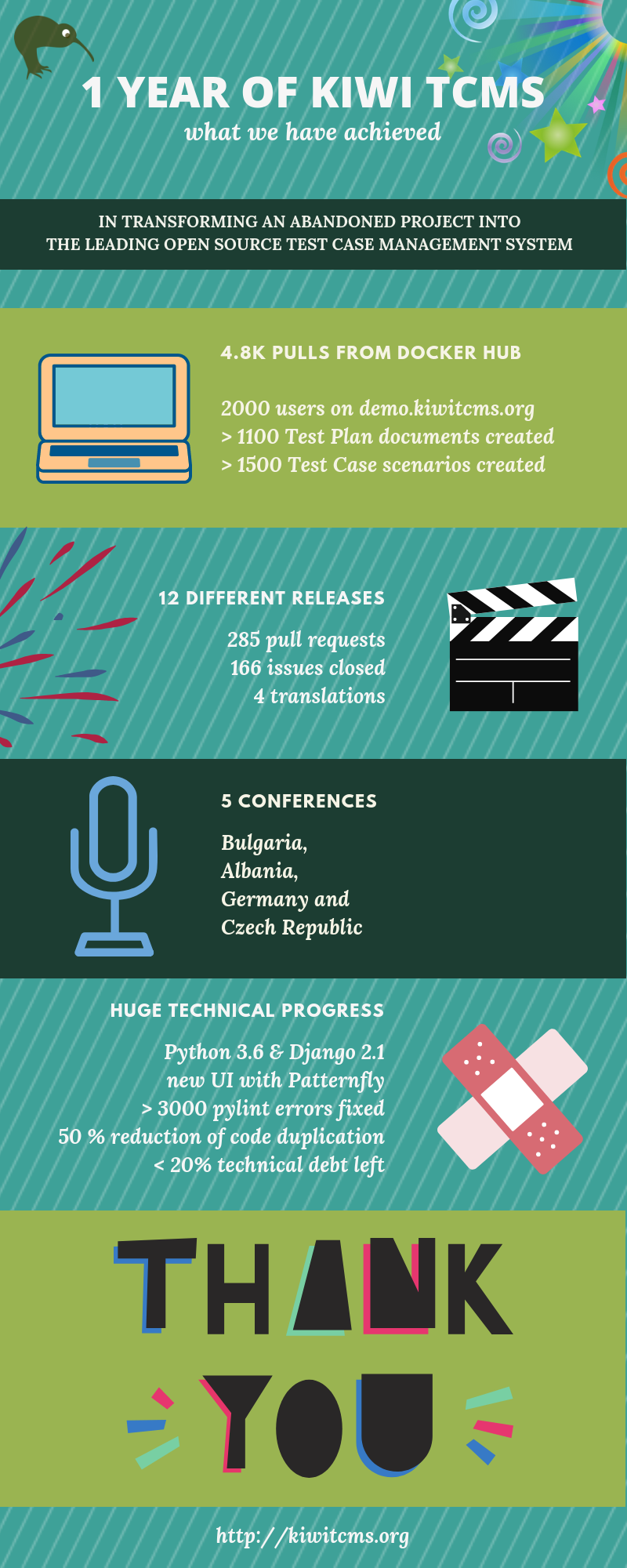
1 year infographic

Hello everyone, in this article I will outline the progress that the Kiwi TCMS team has made towards achieving the goals on our roadmap.

Make code easier to maintain

Status: moderate progress

Initially CodeClimate reported a "D" rating with a 1 year estimated effort. Now it is still on "D" rating with a 7 months estimated effort to bring the project back in shape. Code smells have dropped from 600+ to 418, duplications have been reduced from 600+ to 359! At the same time technical debt ratio has been decreased from 32,5% to 21,6% and little over 10000 lines of code have been removed from the source code. Checkout the stats for more info!

Use pylint and pylint-django

Status: good progress

Both pylint and pylint-django have been integrated into our CI workflow. There are even a few custom built plugins that we use. The number of issues reported is down to around 900 from 4000+ initially. The cleanup has been lead by Anton Sankov with help from Ivaylo Ivanov and myself.

Render HTML, return JSON

Status: no progress

Several views were probably modified to return pure JSON in the meantime but we've not done any targeted work to resolve this issue.

Submit forms, post JSON, GET clean URLs

Status: no progress

Same as above, not much has been done in this area.

API layer

Status: complete

After Kiwi TCMS v4.0 the server side API has been reorganized and updated to follow the model/method names used internally.

After the recent version 5.0 the client side API library has been stripped to its most basic form so that you can work directly with the responses from the server.

There is no more duplication and ambiguity in names because there isn't a lot of code left!

Documentation

Status: moderate progress, dropped

All RPC methods have been documented! The rest of the internals will be documented as we go along.

No vendored JavaScript libraries

Status: moderate progress

Several JavaScript libraries have been removed but we still carry around jQuery and Handlebars.js. No work has been done to convert Kiwi TCMS to use the jQuery version provided with Django.

Less HTML templates with better organization

Status: minimal progress

There are still over 100 HTML templates in Kiwi TCMS. Some of the HTML templates have been merged together, some email templates have been refactored and marked as translatable but the majority of them have not been updated for a long time.

Modern interface with Patternfly

Status: no progress

JavaScript updates and front-end testing

Status: small progress

A number of JavaScript functions have been refactored and removed during the past few releases but there are still thousands of lines of code left to deal with.

Community efforts

Status: moderate progress

We are seeing a steady stream of new users registered on https://public.tenant.kiwitcms.org and there are several active contributors (issues, translations).

Kiwi TCMS was represented at OSCAL Tirana, DjangoCon Heidelberg and PyCon Prague! We're planning to attend HackConf and OpenFest in Sofia by the end of the year.

Happy testing!

Kiwi TCMS conference presence

Kiwi TCMS is going on a small conference tour. This is where you can find us in the next couple of months:

For all of the 3 conferences we're going to have a project presence. In addition to that you can catch-up with Alex Todorov, Kiwi's project lead at: TestCon Moscow(17-19 April, Moscow), Romanian Testing Conference(9-11 May, Cluj-Napoca), PyCon CZ(1-3 June, Prague) and DEVit(10-11 June, Thessaloniki).

If you can ping us at @KiwiTCMS or look for the kiwi bird logo and come to say hi!

Kiwi TCMS roadmap for 2018

Hello everyone. As you know Kiwi TCMS has been around for a while and it has gone through some big changes in the last year! It started as an abandoned Django 1.6 project with broken test suite and is now currently running on the latest Django 2.0.1 with Python 3.5! It is clearly a legacy code base!

We, the Kiwi TCMS team, have learned a lot more about the project and this blog post describes our roadmap for 2018 in terms of technical work and community engagement. The general technical direction is cleaner/simpler code, improved UI/UX and more tests!

Make code easier to maintain

The current code is a bunch of very large modules and functions and classes bundled together. It is also old and sometimes looks like spaghetti code. CodeClimate gives us a "D" rating for maintainability with a 1 year estimated effort to fix that. There are 600+ code smells and 600+ duplications detected by CodeClimate. Our goal is to get this number down to zero!

Use pylint and pylint-django

pylint is the standard static analyzer for Python and currently it reports over 4000 errors and warnings when executed against Kiwi TCMS. This is a huge number and it needs to become zero! We've also identified interesting patterns that will make it into pylint and pylint-django plugins!

Render HTML, return JSON

The current state of affairs is a mix and match of everything. There are views that render HTML, others which return pure JSON, other which return HTML encoded as JSON string and probably everything in between. Views that render pages need to do just that and views that are used with AJAX calls from the UI need to return pure JSON! A lot of these are hiding in plain sight and will come to light when we start overhauling the user interface.

Submit forms, post JSON, GET clean URLs

There are lots of forms in Kiwi TCMS. Sometimes they are submitted by the user and other times they are serialized and POSTed by some JavaScript code. This isn't very easy to understand plus this entire home-grown utility code doesn't bring anything useful to the project. All of these need to be identified and cleaned up. JavaScript code needs to send or consume JSON, nothing else!

There are also lots of places where Kiwi issues GET requests with a number of query parameters. Our goal is to minimize these and where possible have the parameters as part of the Django urls scheme, not as query strings.

API layer

The current API module is a bit disorganized. API namespaces don't match the names of the underlying DB models and the API client classes don't match any of the other two! The way we pass parameters and what these parameters are named should match between the client, the RPC method and the underlying model!

In earlier releases we've removed duplicate or similar RPC methods and we think there are more of these that need our love.

Documentation

We've started producing documentation from doc-strings and most of the RPC methods have such. However it is unformatted and barely readable, sometimes even inaccurate. Previous releases made progress on this but there's a lot more to cover.

All RPC methods should be documented first and then the rest of Kiwi's internals to make development easier!

No vendored JavaScript libraries

There are 11 vendored-in JavaScript files that we carry around in Kiwi TCMS. Most notable are jQuery plus a few addons and Handlebars.js. To the extent possible our goal is to use jQuery provided by Django or installed via NPM dependencies!

Less HTML templates with better organization

There are over 100 HTML templates in Kiwi TCMS. There are also email and even JavaScript templates. For example there are get_cases.html and get_review_cases.html which are essentially the same. This is kind of also true for templates used in new and edit views! Such templates should be unified!

Those JavaScript templates need to be totally gone!

All templates are stuffed together in a single directory and their names are not very predictable. They need to be split per application and follow some kind of naming convention.

Modern interface with Patternfly

The UI already uses the Patternfly library for some of its widgets. Most notably the main navigation header. Our goal is for the entire UI to be ported to Patternfly by updating widgets HTML and CSS where needed. This will also help clean things up a lot. At the same time we'll be rethinking how information is organized on screen and how the person interacts with it! Usability suggestions are very welcome!

This move will also help us get rid of the Handlebars dependency which is now used for pop-up dialogs.

JavaScript updates and front-end testing

There's lots of JavaScript code on the front-end and honestly we don't quite know what it does or how it is organized. There are also no tests on the front-end whatsoever!

It is our goal for this to change with the intention to not overdo the JavaScript part and keep things very minimal. At the moment we're thinking about vanilla jQuery that will act as a proxy between the browser and the back-end!

Community efforts

A year ago hardly anybody knew what Kiwi TCMS was, the project didn't even have this name, there was 1 active contributor and hardly any users! Now the community has started to slowly revitalize, we're seeing some contributions from our junior team members (more on this in another blog post) and also seeing folks installing and using Kiwi TCMS and reporting interesting bugs and feature requests around it!

For the upcoming year our goal is to seek active engagement with other open source projects that could make use of Kiwi TCMS and work with them. Kudos to openSUSE for being the first to propose such integration! We're also planning couple of appearances at a few conferences but there's nothing confirmed yet.

Every other contribution in terms of bug reports, new users and feature requests is of course welcome but we're very conscious of the fact that there's tons of work to be done and the team is still very small!

Team wise we'd like to get the existing team members up to speed and tackle the above tasks with priority. This will also help us introduce bug fixes and new features more quickly!

Happy testing!

Newer Posts

Page 4 / 4